Right-click to translate this page into your own language or use the translation tool in browsers top-right corner:

Your pulse (Heart Beats pr Minute = BPM) is important, but the timing between the heart beats (Heart Rate Variability = HRV) is much more important .
HRV is expressed as Root Mean Square of Successive Differences (RMSSD) as a number in milliseconds ranging from 0 (stressed heart) to 100 or more (relaxed heart).
HRV is one of the most recognized biomarkers for:
- stress and strain
- autonomic balance
- recovery
- sleep quality
- cardiovascular health
- mental well-being
High HRV (RMSSD) = calm, flexibility and healthy autonomic regulation
Low HRV (RMSSD) = stress, strain or imbalance
Over the past few years, heart health has become a very personal topic for me.
Both of my brothers experienced cardiac arrest, and because there was a possibility
of hereditary causes, I went through a series of medical examinations myself.
Seeing my own heartbeats on the screen sparked a deep curiosity: how much can we actually learn about our heart
and stress levels on our own? This led me to explore Heart Rate Variability (HRV) —
a scientifically recognized way of understanding how the autonomic nervous system
regulates the heart.
HRV reflects the variation in timing between heartbeats, and it turns out to be one
of the most meaningful indicators of stress, recovery, sleep quality, and overall
resilience. A high HRV generally signals balance and calm, while a low HRV can
indicate strain or prolonged stress.
To make this knowledge accessible to everybody, I developed a simple Windows-based
HRV & Stress Monitor that works with standard chest straps
(such as Polar or Garmin). It allows anyone to measure their heart rhythm at home,
without exercise, and gain insight into:
- Heart rate and R‑R intervals
- HRV (RMSSD) and stress-related indexes
- Extrasystoles (double beats)
- How breathing, sleep, food, and daily habits influence the heart
- Real-time effects of guided breathing on stress levels
The goal is not to diagnose medical conditions, but to give you a practical,
private observation tool that increases awareness, supports well-being, and helps
document patterns that are often difficult to capture during a short clinical visit.
If you’re curious about your own stress levels, want to understand your heart rhythm
better, or simply want a data-driven way to support healthier habits, you’re welcome
to contact us.
LinTronic have developed an EASY-TO-USE Windows 10/11 Heart Rate Variability (HRV) & stress monitor program, which allows you to read and document your heart rhythm (HRV) in the privacy of your home, while watching tv or reading a book, using a standard chest-strap (Polar H9, Polar H10, Garmin HRM200 - more can be tested/added). No exercises are needed, in fact it works best when you simply rest.
We measure directly on your heart using tested and approved electrode-based chest straps from Polar, Garmin, etc. The program reads and calculates a range of science-recognized heart- and stress-related numbers. An integrated Box Breathing feature, allowing you to practice 2 different ways of breathing, shows how fast you can bring down your pulse and improve your heart rhythm as well as lower your stress.
The manual explains how fitness training, sleep and foods, helps you to improve your overall health.
Each heartbeat is separated by a time interval. The shorter this interval is, the higher your pulse becomes. The longer the interval is, the lower your pulse becomes. The peak of the electrical heartbeat signal is called the R‑point, and the time between two R‑points is called the R‑R interval. Heart Rate Variability (HRV) is the variation in these R‑R intervals. HRV is typically expressed as Root Mean Square of Successive Differences (RMSSD), which is the statistical measure of how much the R‑R intervals change from one heartbeat to the next.
Each heartbeat-time is controlled by two nervous-systems. One nervous-system (parasympathetic) controlling restitution, digestion, etc. will aim to make your heart work slower. The other nervous-system (sympathetic) controlling fight and flight response, will aim to make your heart work faster. Between each heartbeat these two nervous-systems will try to argue which one of them should control the next heartbeat. Therefore the time between heartbeats is constantly going up and down.
For a young and non-stressed heart, both nervous-systems win the right to control the heart on a fifty-fifty basis, and the heart will have a clear variation in the timing between the beats. The time can easily vary between 20 milliseconds or less to 100 milliseconds or more from beat to beat.
Daily and throughout life, we are exposed to situations that stress the body, the nervous-system and the heart: Love, marriage, arguments, alcohol, cigarettes, drugs, sickness, operations, restitution, divorce, financial challenges, custody of the kids, job environment, being fired, getting a new job, moving, traffic, losing friends and family, sleep, etc. Over time we might store the frustration in the body - in the nervous system - which controls the heart.
Each person's situation and possibility to tackle it all is different. In order to help you cope with the many challenges/stress, the sympathetic nervous-system will take over the control of the heart more and more, meaning that the time between the heartbeats will gradually become more tight with less variations.
See the simulation at the top. Click the button to change from less to more stressed.
A less stressed heart
Many variations over 20 ms
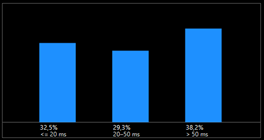
A more stressed heart
Few variations over 20 ms
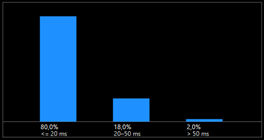
Over time, the heart might begin to produce double beats, called Extrasystoles. Extrasystoles are extra/premature heartbeats that occur before the next normal beat is due. We experience the extra beat as a short spike in the pulse. A double beat is often followed by a timing-adjusting pause which you feel like the heart makes a pause, a flutter, or a strong thump/vacuum in the chest. Nobody really knows why the extra beat occurs.
Extrasystoles - which are shown as short spikes in the pulse - are not dangerous but might cause you to get anxious which creates more stress.
Wrist‑based devices use optical PPG sensors (using light), which estimate heart activity. Because the signal is noisy and highly affected by movement, skin contact, and light interference, these devices must average data over many nights (when it is dark) and reduce HRV to a single wellness trend number. Direct heart measurement with electrodes captures true RR‑intervals from every heartbeat, providing clinical‑grade precision and real‑time insight into your autonomic nervous system.
In simple terms: A wrist‑based sensor is like a weather app. Direct measurement on the heart using electrodes is like a professional weather station. A wrist‑based sensor is like determining a vehicle’s speed from a distance. Direct measurement on the heart using electrodes is like watching the speedometer from inside the car.
🩸 What a PPG sensor basically does
- emits light (typically green, red, or infrared) into the skin
- detects how much light is reflected or absorbed
- converts these light variations into a signal that follows the heart’s pulse waves
- uses rhythmic changes in blood volume as the heart pumps blood, which affects light absorption and makes pulse waves measurable
🔧 How the sensor is built
- LED light sources (green, red, or infrared)
- a photodetector that measures the reflected or transmitted light
- green light for signals in the upper skin layers
- red/infrared light for measurements such as oxygen saturation (SpO₂)
⚖️ Strengths and limitations
Strengths
- easy to ware, non-invasive and comfortable
- low cost and easy to integrate into wearables
- suitable for continuous monitoring
Limitations
- sensitive to motion and light (works best at night)
- affected by skin tone, tattoos, temperature, and sensor placement
- less precise than direct electrical measurements on the heart using electrodes
🩸 What a chest strap basically does
- detects the heart’s electrical signals (similar to a single-lead ECG)
- captures the electrical peak of each heartbeat (the R-wave)
- converts these electrical impulses into a highly accurate heart rate signal
- sends the data wirelessly to a watch, bike computer, or smartphone
🔧 How the sensor is built
- two electrodes placed against the chest to measure electrical activity
- a small transmitter module that processes the ECG signal
- requires moisture or sweat to ensure good skin contact
- uses Bluetooth and/or ANT+ to transmit real-time heart rate data
⚖️ Strengths and limitations
Strengths
- very high accuracy, even during intense training
- fast response to heart rate changes with no delay
- not affected by motion, skin tone, tattoos, or ambient light
- preferred by athletes for interval training and performance tracking
Limitations
- must be worn tightly and correctly positioned on the chest
- can feel less comfortable than wrist-based sensors for long sessions
- requires moisture for optimal electrode contact
- heart rate (beats per minute, BPM)
- RR intervals (the time between heartbeats)
- HRV (Heart Rate Variability and RMSSD)
- double beats (extrasystoles)
- pauses/failures
- a visual, easy-to-understand and objective picture of the heart's stability and the body's stress level,
by receiving heartbeats from approved Bluetooth chest straps (Polar, Garmin, etc.)
- stress level (PNS/SNS/BSI)
- 5-minute baseline for stable data
- variations in heart rate over time with/without controlled breathing
- insight into stress, sleep, diet and training
- objective data for immediate visual understanding
- user friendliness
- documentation
- a powerful tool for both prevention, self-care and dialogue with healthcare professionals.
- reads tested/approved chest straps (Polar, Garmin, etc.)
- the program updates automatically over the internet
- no uninstallation/installation required
- runs on Windows 10/11 machines
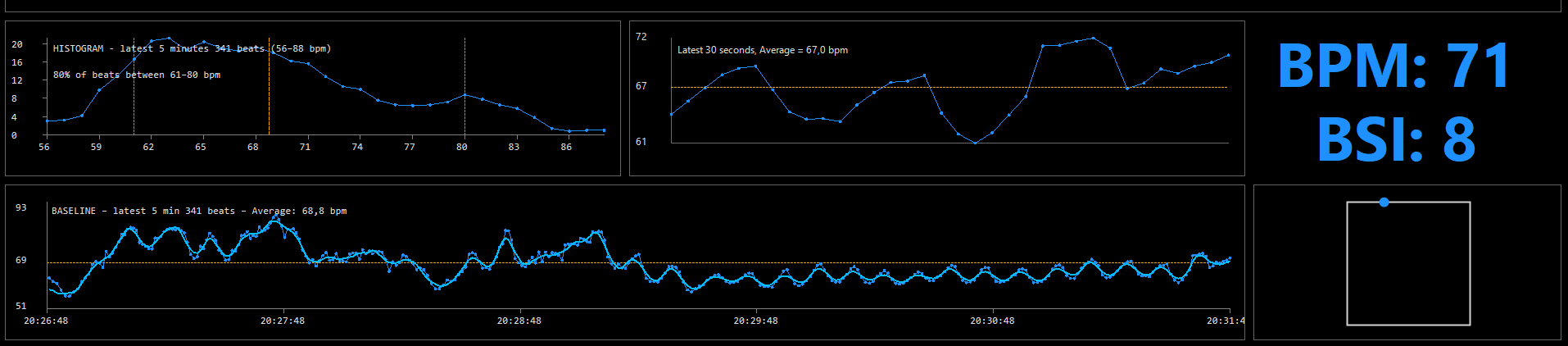
- people with stress, palpitations, extrasystoles or irregular rhythm
- support for prevention and lifestyle changes
- documentation of stress and autonomic dysfunction
- relationship between blood sugar, sleep and HRV
- security at home
- possibility to follow the heart rhythm without a clinic visit
- observation data between consultations
- documentation of episodes that are not captured on the ECG
- support for treatment and stress management
- sleep
- diet
- exercise
- controlled breathing (guidance built-in)
- medicine (e.g. beta blockers)
- lifestyle changes
The program contains easy-to-understand explanations about:
- blood flow (perfusion)
- the importance of sleep for health
- the effect of training on HRV and the heart
- dietary advice, blood sugar, GI and anti-inflammatory foods
- links to experts and sources of inspiration
This makes the program a holistic tool that combines data, knowledge and practical advice.
- controlled breathing (Box Breathing guidance built-in)
- sleep
- training, the 5 zones, HRV excercises
- muscles, protein, creatine
- sedentary work
- smoking
- food, also for diabetes
- increases HRV (RMSSD)
- reduces BSI (stress index)
- improves autonomic balance
- The effect can be quickly seen in the graphs in real time.
Try Box Breathing for 5-10 minutes.
Breath fully in through the nose during 4 seconds (green), hold it for 4 seconds (yellow), breath fully out during 4 seconds (red), hold it for 4 seconds (yellow) - repeat.
Many people experience “vacuum in the chest” or “heart skipping beats” – that are rarely caught on an EKG at the doctor’s.
The program can:
- record extrasystoles
- show pauses/outbursts
- save all heartbeats in Excel format
- document episodes that are otherwise difficult to capture
This makes the program a valuable observation tool that can support both the user and healthcare professionals.
The LinTronic Heart Rate Variability (HRV) & Stress program helps you to become more aware,
document your heart's rhythm, understand double beats nature, focus on your mental health,
letting go of negative thoughts/stress, increase/adjust the frequency of physical and mental
training and sleep, allowing your heart to become more relaxed.
All heartbeats and RR-timing are recorded in Excel-ready text files and the program can re-run
the recording in real-time, so you can show your doctor.
The program documents/stores all of your heart beats in log files, that can later be opened for further study. You can zoom in on a specific area which is then redrawn below.
The program is optimized for user being awake and relaxing. This image is a recording of a full nights sleep. The high spikes are caused by the chest strap being effected when user turn in the bed.
As the development moves on, we will add features helping you to interprete the data. This image shows a very relaxed sleep with a BSI stress factor of only 1 and a good HRV based on age and stress.
Being aware of your heart and managing your stress is important, hence a wide number of well-known and recognized index numbers is calculated from your heartbeats telling you about your heart and stress level. These numbers are for example RMSSD, PNN20, PNN50, PNS, SNS and BSI (used to monitor astronauts). The manual explains these numbers.
Many hours of research and testing have gone into the development of this program, but the program is not approved by doctors or health authorities and does not replace an ECG or other clinical examination. If you have concerns about your heart or your health, you should always contact a doctor or health professional. The program increases your awareness of important numbers, but should be considered a "private observation tool", not a "clinical diagnostic tool".
The program is primarily designed to create awareness of your heart rhythm and possible stress and verify improvements. The results should be considered indicative and the program should not be used as a substitute for medical equipment or professional judgment, although the program helps to detect situations that often do not occur during a measurement with an ECG device at the doctor's and helps the doctor see more clearly what you are experiencing.
Users remain 100% anonymous. All measurements are private and stored locally on your computer. No data is stored or shared online.